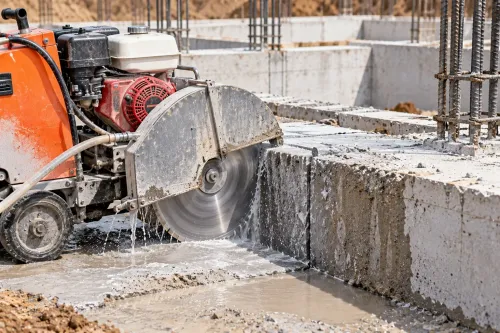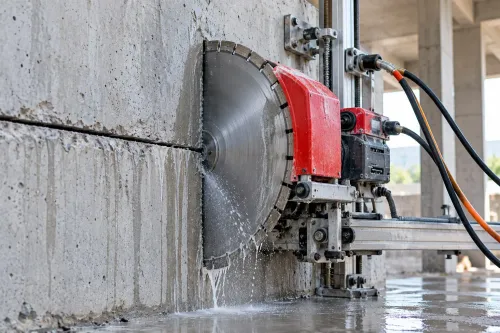

A floor cut can create a service trench, isolate a repair panel, form a joint or open space for equipment, but the correct method depends on the slab, the embedded services and the size of the removal. By the end, you will be able to match each application with suitable cutting equipment, identify structural and site risks, and compare contractors using measurable evidence.
Key takeaways
- Use floor sawing for straight, controlled cuts in concrete slabs.
- Choose wall, wire or handheld saws when access or geometry rules out floor sawing.
- Scan for embedded services and confirm cut depth before sawing.
- Compare contractors on method, safety controls, reinstatement and documented experience.
Where floor sawing earns its place on commercial and industrial sites
Diamond floor sawing earns its place wherever a concrete floor needs a straight, controlled boundary rather than uncontrolled breakout. The applications differ across warehouses, distribution centres, factories, parking decks, retail units, hospitals, offices, data centres and service corridors.
1. In warehouses and distribution centres, warehouse slab cutting forms contraction and control-joint layouts, construction-joint boundaries and repair-panel perimeters. In high-load areas, the cut is a deliberate weakened plane, not automatically a structural separation joint; dowels or plate systems for load transfer, and isolation details around columns or equipment, require separate design.
2. Industrial floor sawing creates narrow trenches for drainage channels, electrical ducts, plumbing, process-water lines and machine services. Factory floor cutting also isolates equipment foundations, machine bases and sections requiring controlled slab removal, reducing breakout beyond the marked perimeter.
3. Retail units, hospitals, offices and service corridors use saw cuts for plumbing routes, service risers, sump work, access openings and lift-pit or stair openings. Coordinate every penetration with waterproofing, vapour barriers, fire-rated floor assemblies and structural toppings.
4. Parking deck cutting patterns applicable to floor openings and repairs only can define repair panels, drainage routes and access openings. Sawing does not remove remaining mesh, dowels, thickened edges, pile caps or embedded steel; those items need separate removal planning.
5. Confirm whether the floor is ground-bearing before cutting. Suspended, beam-and-slab, hollow-core and post-tensioned floors can conceal load paths and tendons, so records, scanning and structural-engineer approval are required before any trench, opening or large repair panel.
How to choose a floor saw, wall saw, wire saw, handheld saw or breaker
Start with the cut, not the machine. Floor saw selection depends on diamond blade cutting depth, slab thickness, reinforcement density, access, geometry, required edge finish and the size of the section to remove.
| Option | Best fit | Main limitation |
|---|---|---|
| Walk-behind concrete saw | Long, straight cuts in an accessible slab | Needs clear access and a stable, level route |
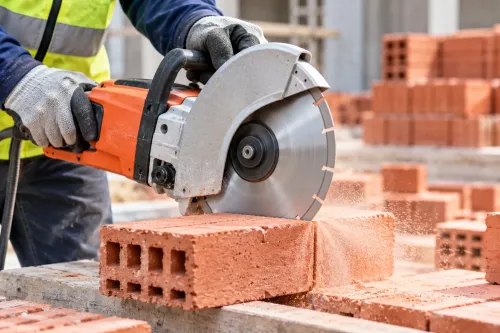
| Handheld concrete saw | Short cuts, corners and confined areas | Limited depth, slower progress and more operator control |
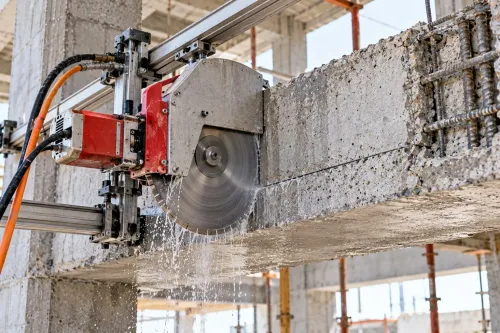
| Wall saw | Controlled cutting where a track-mounted system can reach the required plane | Requires secure track installation and suitable reaction space |
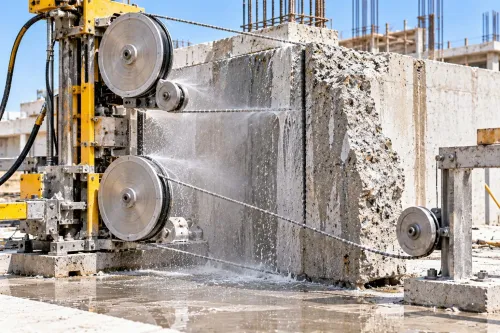
| Wire saw | Unusually thick, heavily reinforced or geometrically difficult sections | More setup, equipment and slurry management |
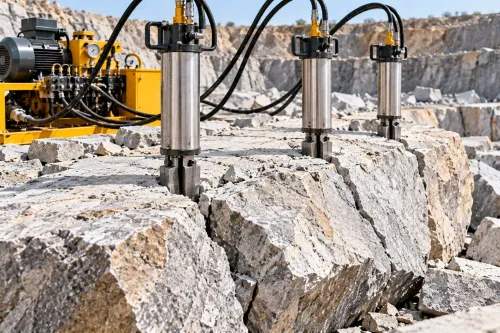
| Breaker | Rough, irregular demolition where edge quality and low vibration have little value | More vibration, noise, dust, debris and damage risk |
A handheld concrete saw comparison with breaker demolition usually favours the saw for a short, cleaner cut near finishes; choose the breaker for fast, irregular breakout where a sawn edge adds no value. A low-vibration method is not automatically safe: it can still cut reinforcement, tendons, conduits or waterproofing.
Before choosing equipment, provide:
- Slab thickness, concrete strength and age, aggregate hardness, reinforcement layout and post-tensioning records
- Embedded utilities, floor finish, access route, working hours and water-disposal limits
- Required cut depth, line accuracy, removal size, lifting method and reinstatement plan
Do not treat a linear-metre rate as comparable unless it states depth, concrete composition, reinforcement, access and slurry controls. A saw cut also does not remove dowels, mesh, thickened edges, pile caps or embedded steel left in the section.
What must happen before and during a floor cut
Set out the cut line from the approved drawing, mark the removal zone and protect adjacent finishes before equipment arrives. Confirm whether the floor is ground-bearing, suspended, beam-and-slab, hollow-core or post-tensioned.
1. Complete GPR concrete scanning or another suitable locating method for reinforcement, post-tensioning tendons, conduits, pipes and voids. Reconcile the scan with structural drawings and utility-owner information.
2. Treat scan results as evidence, not certainty. Congested steel, moisture, depth and changing materials can limit detection and interpretation, so do not rely on a scan alone where the consequence of a strike is serious.
3. Obtain structural engineer slab opening approval when the cut changes a load path, removes slab, creates a large opening, approaches a column, beam, load-bearing wall, slab edge, machine anchor or joint, or intersects reinforcement or tendons.
4. Isolate the work area with barriers and signage. Protect electrical supplies with suitable isolation, residual-current protection and cable routing, then install wet diamond cutting slurry control and protect drains from slurry entry.
5. Set the saw square and stable, verify blade depth, water flow and guarding, and make staged cuts rather than forcing one deep pass. Keep people clear of the blade and the potential fall or movement path of the section.
6. Lift the separated section with planned equipment, or break it out only after the cuts have released it. Remove residual mesh, dowels, thickened edges and embedded steel separately.
7. Inspect the remaining slab for cracking, spalling, exposed reinforcement and unintended damage, then clean and record the opening.
Post-tension tendon locating deserves special attention: tendon damage can release stored force, cause local concrete failure and lose prestress. Never infer tendon positions from visible joints or drawings alone.
The practical cost of using diamond cutting instead of impact demolition
Diamond cutting costs more planning time, but it can reduce damage, dust and disruption in occupied or sensitive areas. The specification must price layout, scanning, saw setup, water supply, cutting, removal and reinstatement—not just blade time.
| Factor | Diamond saw | Pneumatic or electrical breaker |
|---|---|---|
| Vibration and noise | Low vibration; controlled noise | High vibration and impact noise |
| Dust and debris | Wet cutting limits respirable silica dust; smaller debris volume | More airborne dust and loose debris |
| Edge and speed | Straight, accurate edges; fast on long runs after setup | Fast for small irregular breakout; rough edges |
| Nearby risks | Lower risk to finishes, equipment and occupants | Greater risk of cracking, movement and impact damage |
Programme the concrete slab removal logistics in this order:
- Set out and scan for reinforcement, tendons and services.
- Establish saw access, electrical protection, water supply and slurry containment.
- Cut in stages, then remove residual mesh, dowels, thickened edges, pile caps or embedded steel.
- Lift, haul and dispose of sections before cleaning and reinstatement.
Wet cutting slurry disposal requires drain protection, collection, slip control, drying time and lawful wastewater handling. Sawing does not replace full-depth demolition where steel or structural thickening remains.
Choose another method for loose fill, highly irregular rock, very small isolated cuts, inaccessible routes, no-water environments or demolition where a clean edge has little value. This is when not to use diamond floor sawing.
Around penetrations, coordinate waterproofing, vapor barriers, fire-rated floor assemblies and structural toppings; restoring only the concrete leaves leaks or noncompliance. A clean cut also adds little value if the assembly must be broken out wholesale.
How to specify, compare and verify a floor-cutting contractor
A linear-metre price is meaningless unless every bidder prices the same cut. Your concrete cutting contractor comparison must state depth, access, concrete and reinforcement conditions, controls and reinstatement.
| Option | Record in the bid | Why it matters |
|---|---|---|
| Floor saw | Maximum depth, blade diameter, concrete strength, aggregate hardness, reinforcement limit and line tolerance | Predicts productivity, blade wear and edge quality |
| Wet or dry | Method, water supply, slurry containment, drain protection and dust controls | Prevents silica exposure, flooding and hardened slurry |
| Site delivery | Scan process, operator experience, floor saw method statement, risk assessment, permits, isolation plan and lifting equipment | Exposes hidden safety and programme gaps |
| Completion | Disposal route, waste responsibility, repairs and reinstatement | Stops cleanup and repair costs becoming yours |
- Marked-up drawings, scan records, photographs, cut and removal logs, waste documentation and engineer sign-off where applicable.
- The planned route, working hours, access restrictions and responsibility for isolating electrical, plumbing and process services.
- The maximum permitted deviation, cutting depth and exposed-steel treatment; a saw cut does not remove dowels, mesh, pile caps or thickened edges.
Perform a cut-line accuracy inspection with a tape, straightedge and level, then confirm depth at recorded points. Photograph exposed reinforcement, check edge spalling, inspect the remaining slab for cracking or damage, remove slurry and debris, and verify that utilities were checked before cutting.
A Nagpur buyer can assess Salasar Demolitions Pvt Ltd against these same records alongside other specialists; equipment ownership and a low-vibration claim are not proof of competence. Require slab cutting documentation before payment.
Related products
 | Diamond Sawing BEAM CUTTING BY Diamond SAWING Cutting of R C C floors Roads Walls Beams & Column Without any vibrations & shocks to the surrounding structures to carry out any Post Construction... View product → |
 | Road Cutting With Floor Sawing A concrete saw (often known as a consaw or road saw) is a power tool used for cutting concrete, masonry, brick, asphalt, tile, and other solid... View product → |
Frequently asked questions
Where is diamond floor sawing used?
It is used for controlled cuts in warehouses, distribution centres, factories, parking decks, retail units, hospitals, offices, data centres and service corridors.
When should you choose a floor saw instead of a wall saw, wire saw, handheld saw or breaker?
Choose a floor saw for straight cuts in horizontal slabs. Use other methods when the work involves vertical concrete, irregular geometry, restricted access or impact removal.
What must happen before cutting a concrete floor?
Mark the cut, confirm the required depth, identify embedded services and plan water management, access, exclusion zones and debris removal.
Why compare diamond cutting with impact demolition?
Diamond cutting creates a defined boundary with less uncontrolled breakout, while impact demolition can suit bulk removal where finish quality and vibration control are less important.
How do you compare and verify a floor-cutting contractor?
Check the proposed cutting method, depth, equipment, service-detection process, safety controls, waste plan, reinstatement scope, insurance and relevant project evidence.