A hard-rock excavation beside a foundation, buried utility or occupied building cannot tolerate the shock, flyrock and access demands of every breaking method. Hydraulic splitting creates a planned fracture through drilled boreholes, but its success depends on rock structure, hole geometry, equipment access and the way fragments will be removed. By the end, you can judge whether the method suits your site and identify the controls a contractor must document.
Key takeaways
- Use aligned boreholes to create the intended fracture plane.
- Choose splitting when vibration, noise, or flying debris threaten nearby assets.
- Match borehole diameter, depth, spacing, and orientation to the rock.
- Require a documented sequence, exclusion zone, and waste-removal plan.
How the Hydraulic Splitter Creates a Controlled Fracture
A drilled line becomes a useful separation plane when each borehole positions a splitter so its expanding wedge pushes across the intended break, not along it. Hydraulic rock splitting uses tensile stress to link local cracks between holes in a static fracture.
1. Drill boreholes to the specified diameter, depth, spacing and alignment. Flush out cuttings and verify each hole; a blocked, collapsed or oversized hole can prevent proper wedge engagement.
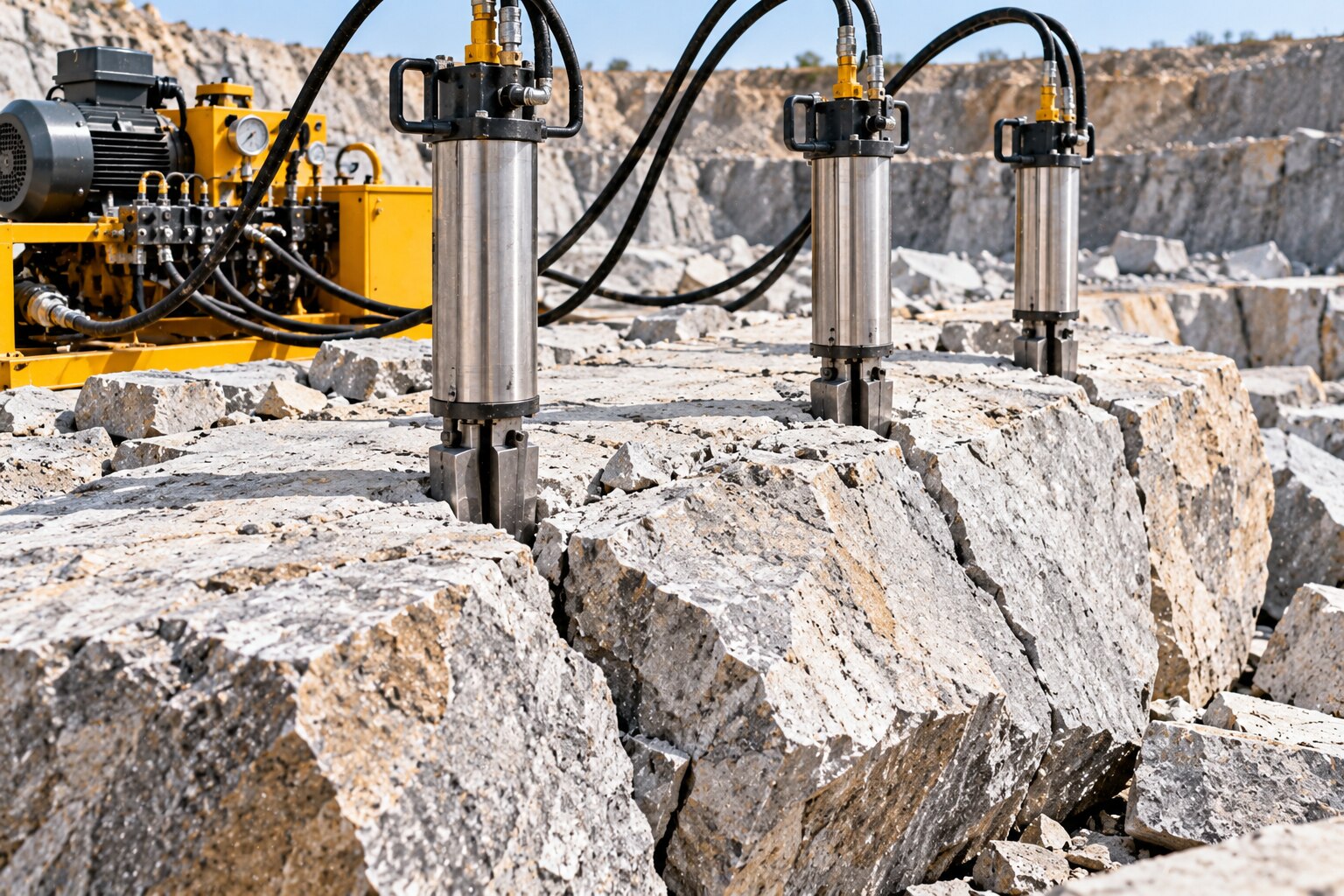
2. Insert the splitter, consisting of a hydraulic cylinder, central wedge and two feathers. The feathers bear against opposite sides of the borehole while the wedge forces them apart.
3. Operate the pump to extend the cylinder in a planned sequence. Each wedge creates concentrated tensile stress, and neighbouring cracks connect along the drilled line toward a free face, joint or starter slot.
4. Release pressure after the fracture opens, then lift, lever, crop or hydraulically break the loosened pieces. Splitting creates the break; it does not remove every fragment.
Pump pressure alone does not show the force reaching the rock. Compare the manufacturer’s rated splitting force and borehole requirements, because cylinder area, wedge geometry, friction and insertion depth control the result.
A completely confined block may crack around individual holes without separating. Staged splitting, a starter slot or a free face gives the fracture somewhere to travel; inaccurate drilling can instead leave an unbroken web or shift the break into retained rock.
Why Splitting Fits Restricted Areas Better Than Impact Methods
Beside a retained structure or live service, the main advantage is a smaller, more predictable release of energy than impact breaking or controlled blasting. The hydraulic wedge and feathers work inside drilled holes, reducing the repeated hammer blows that can transmit shock through a foundation, slab or service trench.
The method removes these blasting hazards:
- Flyrock that can strike people, façades, plant or exposed services
- Blast fumes that need clearance and ventilation
- Airblast that can damage glazing, doors or sensitive equipment
Access is also easier in locations where a breaker cannot swing or explosives cannot be stored:
- Beside occupied buildings
- Near live utilities
- Inside basements, tunnels and confined excavations
A compact drilling rig, pump and hoses still need a stable route and a safe working position. The work is not hazard-free: a partially detached block can move suddenly when the crack completes, and hoses, machinery and falling fragments require guarding and an exclusion zone.
Low vibration does not mean zero vibration. Drilling, steel contact, block movement and later hydraulic breaking can still affect a sensitive building, so assess the complete sequence rather than the wedge stroke alone.
The trade-off is production speed. Splitting is a primary-fracturing method: you drill, split, then lift, lever, crop or break the pieces. Handling can dominate the programme in deeply confined rock, making controlled blasting or bulk excavation faster in a large open cut where vibration limits are not restrictive.
How Rock Conditions and Borehole Geometry Decide the Result
If a planned crack dies halfway, the cause is usually the rock mass or the drilled pattern, not insufficient pump pressure. Bedding, foliation, joints, weathering, confinement and the available free face determine whether tensile stress joins the holes into one separation plane.
| Site or rock condition | Likely result | Design response |
|---|---|---|
| Continuous granite or basalt with a free face | A clean crack can propagate between adjacent holes | Set the line toward the free face and use the splitter’s rated force |
| Open joints or bedding crossing the line | The crack diverts along the weaker plane | Map discontinuities and change the line or hole sequence |
| Weathered, fractured or variable rock | Local breakout and uneven fragments | Reduce hole spacing and inspect each hole before splitting |
| Completely confined block | Local cracking without useful separation | Create a starter slot, free face or staged opening |
| Rock beside a foundation or utility | An unintended plane can transfer movement | Keep the line clear of the structure and verify alignment |
Borehole geometry must match the wedge pack. Confirm the specified borehole diameter, because a hole that is too large reduces wedge engagement while a narrow hole prevents insertion; commercial equipment commonly uses about 25–50 mm holes.
Check borehole depth as well: shallow holes limit wedge contact, while excessive depth wastes drilling and can place the force below the intended plane.
Hole spacing reflects wedge length and splitting force, not rock strength alone. Closer spacing improves control but increases drilling time; set it against the required fragment size and whether the crack runs parallel or perpendicular to bedding, foliation or jointing.
Use alignment checks, flush out cuttings, and reject blocked, collapsed or water-filled holes before forcing in the splitter.
Where Splitting Sits in the Excavation Sequence and Method Choice
Choose hydraulic splitting when boundary control matters more than maximum bulk output: beside foundations, live services, occupied plant rooms, tunnels or basements where explosives are prohibited and repeated impact is unacceptable. It is a primary-fracturing method, not usually a complete removal method.
| Option | Prefer it when | What follows |
|---|---|---|
| Hydraulic splitting | You need a planned separation with low ground shock and little access for equipment | Lift, lever, crop or break the separated blocks |
| Pneumatic breaker or hydraulic breaker | The excavation is open, production speed matters and vibration limits are manageable | Continuous breaking, spoil handling and boundary trimming |
| Expansive demolition grout or chemical splitting | Drilling is possible but silent, delayed expansion is acceptable | Wait for expansion, then remove fractured pieces |
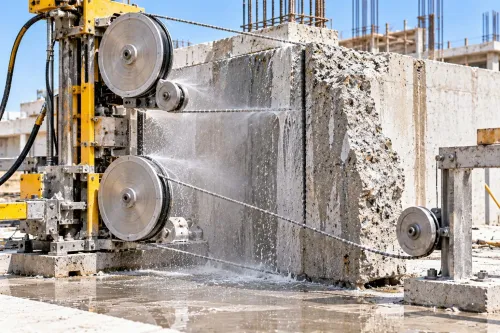
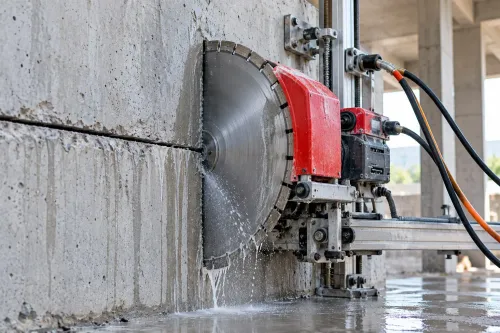
| Diamond wire sawing | You need a precise cut through accessible, relatively clean rock or concrete | Manage slurry, cooling water, wire access and cut-piece lifting |
Use this sequence to judge the real programme:
- Drill and verify the hole line, depth, spacing and orientation before committing the splitter.
- Split the mass in planned lifts, starting where the fractured block has room to move.
- Remove loosened pieces with lifting gear, a lever, excavator or breaker; dense blocks can erase the time saved during splitting.
- Reserve secondary breaking for isolated remnants, not the retained boundary.
Low vibration does not mean zero vibration: drilling, steel contact, falling blocks and secondary breaking still need monitoring. A proposal from Salasar Demolitions Pvt Ltd should therefore show the complete removal sequence, not only the splitter’s rated force or hydraulic pressure.
Related products
 | Eco-Friendly Rock and Concrete Breaking. Rock Surgeons specialize in safe rock breakup of bedrock, boulders and concrete. View product → |
 | Eco-Friendly Rock and Concrete Breaking. Rock Surgeons specialize in safe rock breakup of bedrock, boulders and concrete. View product → |
What to Require Before Awarding Restricted-Access Rock Work
Do not compare proposals by pump pressure or hourly rate alone. Require a method statement covering drilling, splitting, secondary breaking, block removal, exclusion zones, dust or slurry control, hose protection and work beside retained structures.
Ask every bidder to provide:
- A marked-up plan showing borehole diameter, depth, spacing, alignment, split direction, access width and drilling positions.
- Rock investigation records, including rock type, weathering, discontinuities, groundwater and estimated block sizes.
- A lifting plan naming the equipment, rated capacity, lifting points, travel path and landing area.
- A production schedule separating drilling, splitting, cropping, lifting and disposal.
- A control plan specifying vibration monitoring locations, alarm and stop levels, noise control, dust suppression and exclusion zones.
- Evidence from comparable restricted sites, operator competence records, equipment inspection certificates and the manufacturer’s rated splitting force and borehole requirements.
| Proposal item | Comparable measure | Query or reject when |
|---|---|---|
| Drilling | Holes per shift, diameter, depth and accuracy | The rate excludes setup, re-drilling or slurry removal |
| Splitting | Rated splitting force and cycle time | The bidder gives pump pressure but no force rating |
| Removal | Maximum block weight and lifting route | No lifting plan covers partially detached blocks |
| Protection | Baseline readings, trigger levels and monitoring points | No vibration monitoring or noise control is specified |
| Output | Complete sequence to disposal | Cubic metres per day hides secondary-breaking time |
Require a site walkover before award. It exposes rig-clearance problems, live services and handling routes that a neat drawing can miss.
Frequently asked questions
How does a hydraulic rock splitter create a controlled fracture?
A splitter’s expanding wedge applies tensile stress inside a drilled borehole. Cracks link between aligned holes to form the planned separation plane.
Why is hydraulic splitting suitable for restricted areas?
It produces less vibration, noise, and airborne debris than impact breaking or blasting, helping protect nearby structures and occupied areas.
How do rock conditions and borehole geometry affect splitting?
Rock strength, jointing, bedding, weathering, borehole diameter, depth, spacing, and alignment determine whether cracks follow the intended line.
Where does hydraulic splitting fit in an excavation sequence?
Use it after surveying and drilling to release rock sections, then remove the fractured material with suitable lifting, loading, or secondary-breaking equipment.
What should you require before awarding restricted-access rock work?
Request the proposed method statement, borehole layout, equipment details, sequence, monitoring plan, exclusion controls, waste-removal method, and evidence of relevant site experience.